
Table of Contents
ToggleIf you’re tired of manually adjusting your thermostat or watching energy bills climb, the GE Smart Thermostat might be worth your consideration. Smart thermostats have become one of the easiest home improvements to install yourself, offering real savings on heating and cooling without requiring a contractor. This review breaks down what the GE Smart Thermostat delivers, how it stacks up against competitors, and whether it fits your home’s setup. Whether you’re a first-time smart home buyer or upgrading from an older model, you’ll find the practical information you need to make an well-informed choice.
Key Takeaways
- The GE Smart Thermostat offers multi-ecosystem compatibility with Google Home, Alexa, Apple HomeKit, and Samsung SmartThings, making it ideal for homes with mixed smart devices.
- Installation is a DIY-friendly project taking 30–45 minutes for most homeowners, requiring only basic tools and no special electrical knowledge.
- Real-time energy monitoring helps identify usage patterns and potential HVAC issues, with potential savings of 10–15% through intelligent scheduling.
- Priced at $120–$160, the GE Smart Thermostat delivers a strong price-to-feature ratio compared to premium competitors like Nest and Ecobee.
- Your system must have a C wire or support a power adapter ($30–$50) for the thermostat to function; verify compatibility before purchasing.
- The GE Smart Thermostat lacks advanced learning capabilities and limited customization options compared to pricier models, making it best for straightforward remote control needs.
What Makes the GE Smart Thermostat Stand Out
The GE Smart Thermostat, often sold under the GE Cync brand, focuses on simplicity and energy tracking without requiring a complicated setup process. Unlike some competitors that demand extensive app customization to feel useful, the GE model delivers straightforward temperature control and real-time power consumption data out of the box.
The standout advantage is its compatibility with multiple smart home ecosystems. It works with Google Home, Alexa, Apple HomeKit, and Samsung SmartThings, which means you’re not locked into one vendor’s ecosystem. If you own a mix of smart devices from different manufacturers, which most homes do, this flexibility matters.
Installation is a genuine DIY project for most homeowners. The unit ships with a clear wiring diagram and a built-in guide that walks you through identifying your existing thermostat wires. You’ll need basic tools: a wire stripper, a screwdriver, and a phone or tablet to complete setup. The whole process typically takes 30–45 minutes, even if you’ve never opened a thermostat before. No special electrical knowledge required, though you should turn off power at your breaker before starting.
Key Features and Smart Capabilities
Mobile App Control and Remote Access
The GE Smart Thermostat app lets you change your home’s temperature from anywhere with an internet connection. This feature pays dividends if you forget to adjust the heat before leaving for vacation or want to warm the house before arriving home on a cold evening.
The app displays your current temperature, target temperature, and the system status (heating, cooling, or idle) in real time. You can set custom schedules for weekdays and weekends, create vacation mode to prevent heating an empty home, and receive notifications if something goes wrong with your HVAC system.
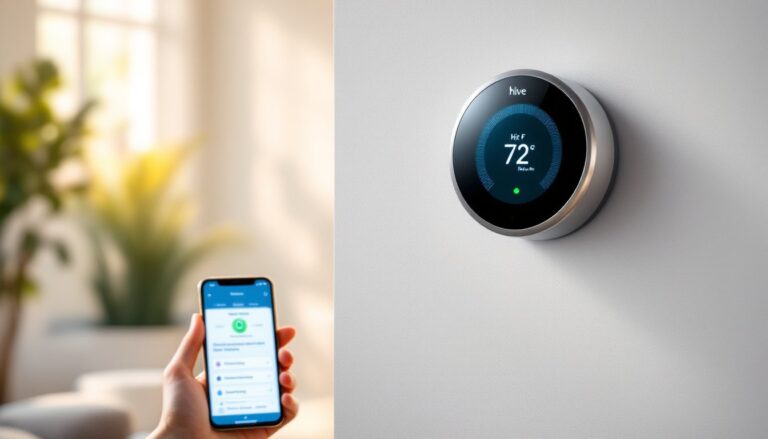
Remote access works through both the native GE app and voice assistants. If you use Google Home or Alexa, you can say commands like “set the temperature to 72” without touching your phone. The experience is straightforward, no complex voice syntax required. According to leading smart thermostat reviews on CNET, remote control reliability is a top priority for users, and the GE model performs consistently.
Energy Monitoring and Savings
This is where the GE Smart Thermostat earns its position in any energy-conscious household. The app shows a detailed breakdown of your heating and cooling usage: how many hours your system ran, when it was most active, and estimated cost of operation.
You can compare this month’s usage to the previous month and see trends over time. If you notice your heating bill doubled without your thermostat triggering more runtime, it might signal a maintenance issue, a clogged filter, poor insulation, or a failing compressor. Catching these early saves money and extends equipment life.
The thermostat also supports intelligent scheduling. Set it to lower temperatures when nobody’s home and raise them before residents return. Combined with its ability to learn your patterns (some models include basic learning), you can trim energy consumption by 10–15% without sacrificing comfort. Actual savings depend on your climate, insulation, and how aggressively you’re willing to adjust temperatures, but the monitoring alone helps you make informed decisions about your HVAC system.
Energy tracking through the GE Smart Thermostat integrates with broader smart home ecosystems that monitor consumption across your entire home.
Installation and Compatibility Guide
Before you buy, confirm your HVAC system is compatible. The GE Smart Thermostat works with most standard furnaces, heat pumps, and air conditioning systems, but it won’t work with every setup.
Compatibility requirements: Your existing thermostat must have a common (C) wire or your system must support a power adapter (available separately, usually $30–$50). The C wire carries 24-volt power to keep the thermostat running when your heating or cooling system isn’t actively operating. Without it or an adapter, the thermostat won’t stay powered between cycles.
If your current thermostat doesn’t have a C wire, you have options: install a power adapter, run a new C wire from your furnace to the thermostat location (this requires opening your furnace and is more involved), or replace your heating system when it’s due (and request that the installer add a C wire). Check your current thermostat’s wiring before ordering, most have 5–8 colored wires, and the C wire is usually blue or labeled “Com.”
Installation steps:
- Turn off power to your HVAC system at the breaker.
- Remove your old thermostat’s faceplate and take a photo of the existing wires before disconnecting them.
- Disconnect wires one at a time, labeling each with painter’s tape to match the GE diagram.
- Remove the old mounting plate and install the GE backing plate using the existing wall holes (or new ones if the footprint differs).
- Connect each wire to the corresponding terminal on the backing plate, following the diagram provided.
- Snap the new thermostat faceplate onto the backing plate.
- Restore power and follow the in-app setup wizard to connect to your Wi-Fi and name rooms.
The whole process is straightforward for a handy homeowner. If you’re uncomfortable working with electrical wiring, hire a licensed HVAC technician ($75–$200) to handle it instead. Doing it yourself saves money but takes care and attention to detail.
Smartphone compatibility is broad: iOS 13+ and Android 8+ both support the GE app. If you’re using older devices, check compatibility on the GE website before purchasing. The thermostat hardware itself stores settings locally, so it continues to run basic heating and cooling even if the Wi-Fi connection drops.
Pricing, Pros, and Cons
The GE Smart Thermostat typically retails for $120–$160, though prices vary by retailer and seasonal sales. This sits in the mid-range: cheaper than high-end Ecobee models ($200+) and comparable to Nest thermostats. Detailed comparisons between smart thermostat brands show GE competing well on value for basic smart home users.
Pros:
- Multi-ecosystem compatibility (Google, Alexa, Apple, Samsung)
- Detailed energy monitoring and usage reports
- Simple, clean app interface without overwhelming customization
- DIY installation is genuinely achievable for most homeowners
- Good price-to-feature ratio
- Reliable remote access and voice control
Cons:
- Limited built-in learning compared to Nest (Nest actively learns your habits: GE requires manual scheduling)
- Requires a C wire or power adapter, compatibility is a blocker for some homes
- Fewer customization options if you want advanced geofencing or complex automation rules
- Customer support is adequate but not exceptional
- No humidity control on entry-level models (pricier variants may offer it)
If you need a straightforward thermostat that doesn’t demand tech expertise, the GE model delivers. If you want an AI-powered thermostat that learns your schedule automatically, you’ll spend more on a Nest or Ecobee. Exploring broader smart home tech options can help you decide whether a learning thermostat is worth the extra cost.
Is the GE Smart Thermostat Right for Your Home?
Choose the GE Smart Thermostat if you want a no-fuss upgrade to remote temperature control and basic energy tracking without paying premium prices. It’s ideal for homeowners who already own multiple smart home devices from different brands and need something that plays nicely with all of them.
Skip it if your system lacks a C wire and you’re unwilling to install an adapter or call an electrician. Also pass if you’re building a primarily Alexa- or Google-only home and don’t value cross-platform flexibility, there’s no meaningful advantage to GE in that scenario.
For first-time smart home buyers, the GE thermostat is a solid entry point. Getting started with smart home tech doesn’t need to be intimidating, and a simple thermostat is one of the easiest wins you can achieve. The energy monitoring alone often justifies the cost within the first year, and the flexibility to voice-control your climate from another room feels genuinely convenient once you’ve lived with it.
Verify compatibility with your HVAC system, confirm your Wi-Fi signal reaches your thermostat location (weak Wi-Fi creates reliability issues), and be honest about whether you’re willing to DIY the installation or hiring help. Get those three things right, and you’ll likely be satisfied.