
Table of Contents
ToggleYour Yale smart lock keeps your home secure, but only if the battery stays charged. Unlike a traditional deadbolt, smart locks depend entirely on battery power, so understanding how your Yale’s battery works, when it’ll need replacing, and how to maintain it is essential homeowner knowledge. This guide walks you through the whole battery lifecycle, from how the system powers itself to spotting the early warning signs that a replacement is due. We’ll cover what you need to know to keep your lock running smoothly and your door secure.
Key Takeaways
- Yale smart lock batteries typically last 6–12 months on a set of four AA alkaline cells, with usage frequency and temperature significantly affecting performance.
- Replace all four Yale smart lock batteries simultaneously to prevent voltage imbalances and ensure reliable lock operation.
- Watch for warning signs like slow response time, beeping, dimmed LED indicators, and failed app commands—these indicate your battery needs replacement before complete depletion.
- Maintain strong WiFi or Bluetooth signal, keep firmware updated, and monitor your app’s battery percentage monthly to extend battery lifespan and avoid lockouts.
- Always use quality alkaline batteries from trusted brands, store spares in cool, dry locations, and never mix old and new batteries in your Yale smart lock.
How Yale Smart Lock Batteries Work
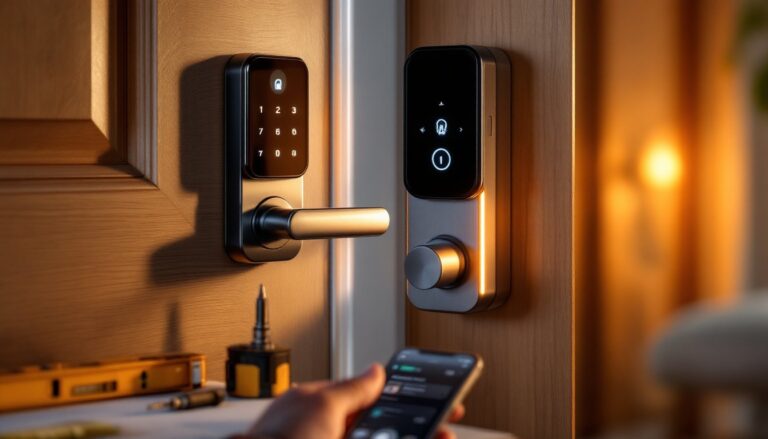
Yale smart locks operate primarily on AA alkaline batteries, with most models using four AA cells as the primary power source. These batteries power the motorized locking mechanism, the wireless connectivity module, and the circuit board that manages your app commands and physical key overrides. The Yale Assure Lock 2, one of the most popular models, relies on this four-AA setup and includes a 9-volt backup battery that activates if the main batteries fully deplete. This redundancy is a safety feature, your lock won’t strand you outside even if you forget a battery change.
Unlike a smoke detector that draws steady current, your smart lock operates in cycles. The motor engages only when you lock or unlock, the wireless chip activates only when receiving or transmitting a signal, and the circuit board draws minimal power in standby mode. This intermittent draw is why battery life can stretch six months to a year, depending on usage frequency and how often you use your phone to control the lock versus the physical keypad or key.
Some Yale models support rechargeable lithium batteries, though alkaline remains the standard. Rechargeable options can be convenient if you remember to charge them, but alkaline batteries offer simplicity and predictable performance. If your model supports both, check your manual, mixing battery types or using incompatible rechargeables can damage the contacts or reduce lock reliability.
Battery Life and Performance Expectations
A fresh set of four AA alkaline batteries in a Yale smart lock typically lasts between 6 and 12 months under normal household use. That timeline assumes moderate daily activity, a few lock and unlock events per day, occasional app checks, and standard wireless communication. Heavy users with frequent remote locking or homes with poor WiFi coverage (forcing more communication attempts) may see batteries drain faster.
Temperature affects performance too. Cold weather slows chemical reactions inside batteries, reducing available power, you might notice slower lock response or dimmer LED indicators during winter. Once temperatures warm, performance usually returns to normal, but extremely cold climates can shorten effective battery life. Heat has the opposite effect, accelerating discharge, so avoid storing spare batteries in direct sunlight or hot garages.
Yale’s app displays remaining battery percentage if your phone and lock are properly connected, which is your most reliable indicator. But, don’t wait until the indicator drops to 10% to order replacements. According to smart home technology reviews on Digital Trends, battery health can degrade unpredictably in the final 20%, and low-power situations sometimes prevent the lock from responding to commands even if the backup battery exists.
Signs Your Yale Smart Lock Battery Needs Replacing
Watch for these warning signs before your lock dies completely:
- Slow response time: The lock takes 3-5 seconds to engage instead of 1-2 seconds. This indicates weakened battery voltage struggling to power the motor.
- Beeping or chirping: Most Yale locks emit audible alerts when batteries drop below 15-20% capacity. Your phone may also send notifications if the app is synced.
- LED indicator dimming: The button’s LED glows more faintly than usual, or doesn’t illuminate at all. This shows the circuit board is rationing power.
- Failed app commands: Your phone shows a lock or unlock command sent, but the mechanism doesn’t respond. The wireless chip may not have enough current to operate the motor.
- Keypad failures: Numbers don’t register when you punch in your code, or the keypad lights don’t illuminate. This is a sign of critically low voltage.
Don’t assume the 9-volt backup will save you if these signs appear. The backup battery exists for genuine emergencies, not daily operation. Relying on it drains that reserve quickly, and if it depletes too, you’re locked out. Replace batteries at the first persistent warning sign, not the last one.
How to Replace Your Yale Smart Lock Battery
Step-by-Step Replacement Process
What you’ll need:
- Four AA alkaline batteries (check your manual for the recommended type: Energizer or Duracell are reliable choices)
- A small flathead screwdriver or coin
- A clean, dry cloth
Step 1: Unlock and open the battery cover
Unlock your door using your phone, physical key, or the keypad. Locate the battery compartment on the interior side of the lock, it’s usually a small panel on the back or bottom. Use your flathead screwdriver or coin to gently pry or unscrew the cover. Don’t force it: Yale uses standard fasteners that turn easily with light pressure.
Step 2: Remove old batteries
Note the orientation (+ and − poles) of the old batteries as you remove them. Take a photo with your phone if you’re unsure. Discard old batteries according to your local recycling guidelines, alkaline batteries shouldn’t go in regular trash. If the contacts look corroded or dirty, wipe them with a dry cloth. Corrosion can prevent good electrical contact, so clean here even if the batteries aren’t visibly gunked up.
Step 3: Install fresh batteries
Insert new AA batteries in the same orientation as the old ones. Press firmly until each battery seats fully. The compartment typically has small springs or contact points that should click or seat as batteries slide in. Don’t mix old and new batteries, always replace all four at once.
Step 4: Close the cover and test
Replace the battery cover and tighten any screws hand-tight. Don’t overtighten, which can strip plastic threads. Test the lock using your phone app, keypad, and physical key. All three should respond within 1-2 seconds. If the lock doesn’t respond, open the cover, reseat the batteries, and try again.
Tip: Some Yale locks display a green LED or send an app notification confirming battery installation. If that confirmation doesn’t appear, double-check battery orientation or contact Yale support.
Tips to Extend Your Battery Life
Maximize your battery lifespan with these practical strategies:
Reduce app-triggered locks and unlocks. Each wireless command draws power. Stick to your physical key or keypad code for routine entries. Reserve the app for convenience, not habit.
Keep your lock’s firmware updated. Yale occasionally releases software updates that improve power efficiency. Check the app or Yale’s website monthly for new versions. A firmware patch that reduces background communication can add weeks to battery life.
Ensure strong WiFi or Bluetooth signal. A weak signal forces your lock to repeat connection attempts, draining the battery faster. If your lock sits far from your router, consider repositioning your router or adding a mesh WiFi system to extend coverage. Strong signal means faster, more efficient communication.
Replace all four batteries at the same time. Don’t swap just the weak one. Mixed battery ages and chemistries cause some cells to discharge faster, leaving the others unable to power the lock fully.
Store spare batteries in a cool, dry place. Heat and moisture degrade battery charge over time. A kitchen drawer is fine: a hot garage or humid basement is not. Buy quality brands, cheap batteries offer less consistent voltage, which can confuse your lock’s power management circuit.
Avoid leaving the lock in extreme cold for long periods. If you have a seasonal property in a freezing climate, consider removing batteries before the winter shutdown. This prevents slow self-discharge in cold storage. Reinstall fresh batteries before you return.
Monitor your app battery readings monthly. Don’t wait for warnings. A quick monthly check gives you time to order replacements before they’re critical. Most failures happen because homeowners ignore low-battery alerts for weeks.
Conclusion
Yale smart lock batteries are straightforward to manage once you understand the basics: use quality AA alkalines, replace all four at once, and pay attention to your app’s battery indicator. Most failures stem from ignoring early warning signs or mixing old and new cells. Stay proactive with monthly checks and firmware updates, and your lock will deliver consistent security without surprise lockouts. Your smart lock is only smart when it’s powered, so treat battery maintenance as routine home care, not an afterthought.